There are many different ideas about how coaches should organize an FLL team. Some of the organizational methods are good, some not as good. The key thing is to come up with a way that fits you’re (or the coaches) organizational style…unless that style is chaotic, I haven’t seen that style work yet.
These are my thoughts based on watching teams from either a mentor’s perspective or as someone who was brought in to teach/trouble shoot/guide for a short time, which seems to be something I do a lot of. I’ve also read others FLL’ers thoughts on team organization. Here are some of my thoughts.
- The coach doesn’t need to be technical – just good with kids and organized. Understanding NXT-G programming and building helps. The FIRST organization has some good information on coaching on their international FLL site.
- Recruit parents/mentor’s – The coach can’t do it all, you need help. They can help keep the kids on task with the project and robot missions moving. Mentors can really help with the programming and building ideas.
- Manage and Administer the team – keep the team organized and moving toward the FLL competitions. Set practice schedule, meet deadlines from FIRST (i.e. registration, event sign up, etc.), and getting things done on time. A bigger task is sometimes managing the parents (probably the hardest part). Don’t let the parents use the FLL meetings as “babysitting”. If kids don’t want to be there, then they don’t need to be there.
- Kid interaction – Depending on the mix of maturity of the kids, this can be tough. And, yes, there may be some crying and hurt feelings. Also recruiting the right mix of kids. Some want to be technical only (i.e. work on the robot) and some want to be project oriented. Some want to tell everyone else what to do. All of this needs to be managed.
- Time management – have a schedule and stick to it. As an Engineer, I know the schedule will most likely be missed, but it’s a goal to shoot for. Keep the meetings on time (for the sake of the parents).
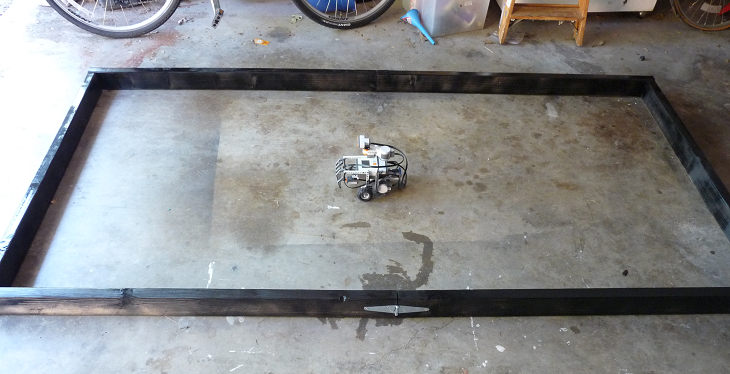
- Area organization – There needs to be enough room for kids to work on the robot missions (4×8 ft table plus area to move around the edge, about 2 ft on each side. There also needs to be enough area for work on the project. This depends on the project, building/creating the parts of the project and area to practice. Also, a storage area for mission models, project parts, and table storage.
- Stay connected – Communicate with other coaches and regional groups. The North Texas FLL forum is at (). Don’t go through this on your own. If you need to contact me (frc704mentor@qweztech.com) and I’ll check my contacts to find out who can help in your area. If you’re in North Texas, I can help.
Volumes have been written on coaching so do some reading.
Kid management and robot resource management is another topic. If there is only one brick (Robot Brain) this can be tough.The main thing I have is patience. Since all kids are different this is more of a coaches issues to determine how to organize the kids based on their personalities. Here are some suggestions on organizing the kids.
First, have the team come up with a basic chassis design that will accommodate attachments and can move around the field. This would include, at minimum, a light sensor for line following. Have the best builders build the chassis.
1. My belief is to let every kids who wants to work on the robot, work on it. The robot portion FLL is organized into missions. They can be logically grouped for the robot to do multiple missions after leaving the base. A good idea is to pair up the kids and have them make the robot do a set of missions. They both work on the programming and the attachments for the mission. Not all kids have a technical aptitude but, I believe, that if they do, it should be nurtured. Also, have the kids help each other if some of them get stuck.
2. At significant milestones in the missions, have the robot pair present what they did to the group (not every meeting). That way, every one kind of knows what’s going on and it helps toward team work.
3. All the kids need to work on their project. Most of the time, when one pair is working on the robot, have the others working on the project. Occasionally everyone will need to work on the project for presentation organization.
4. The kids need to work as a team. Work together, value each other’s ideas, and value each other. There will be the overpowering kids, the ones to talk a lot and telling others what to do. However, there will also be the quiet kids who think things out. These kids need to be given the time to be heard and their ideas are listened to as much as the overpowering kids ideas. These are the introverts (which is a great thing) whose ideas will become the next Google or get a colony on another planet.
· Los Altos Robotics (http://www.losaltosrobotics.org:8080/Main/FLL/coaching.html)
· FIRST Lego League Coaching (http://www.legoleaguecoaching.org/)
· FLL Resources (http://firstlegoleague.org/challenge/teamresources)
Dr. Ken Berry (Head Referee for the North Texas Region)